

October 26, 2026
Do dvd players and vcrs go in the recycling bin?
Old DVD players and VCRs usually do not belong in curbside recycling. Use e-waste drop off, donation, repair, or local bulky trash rules.
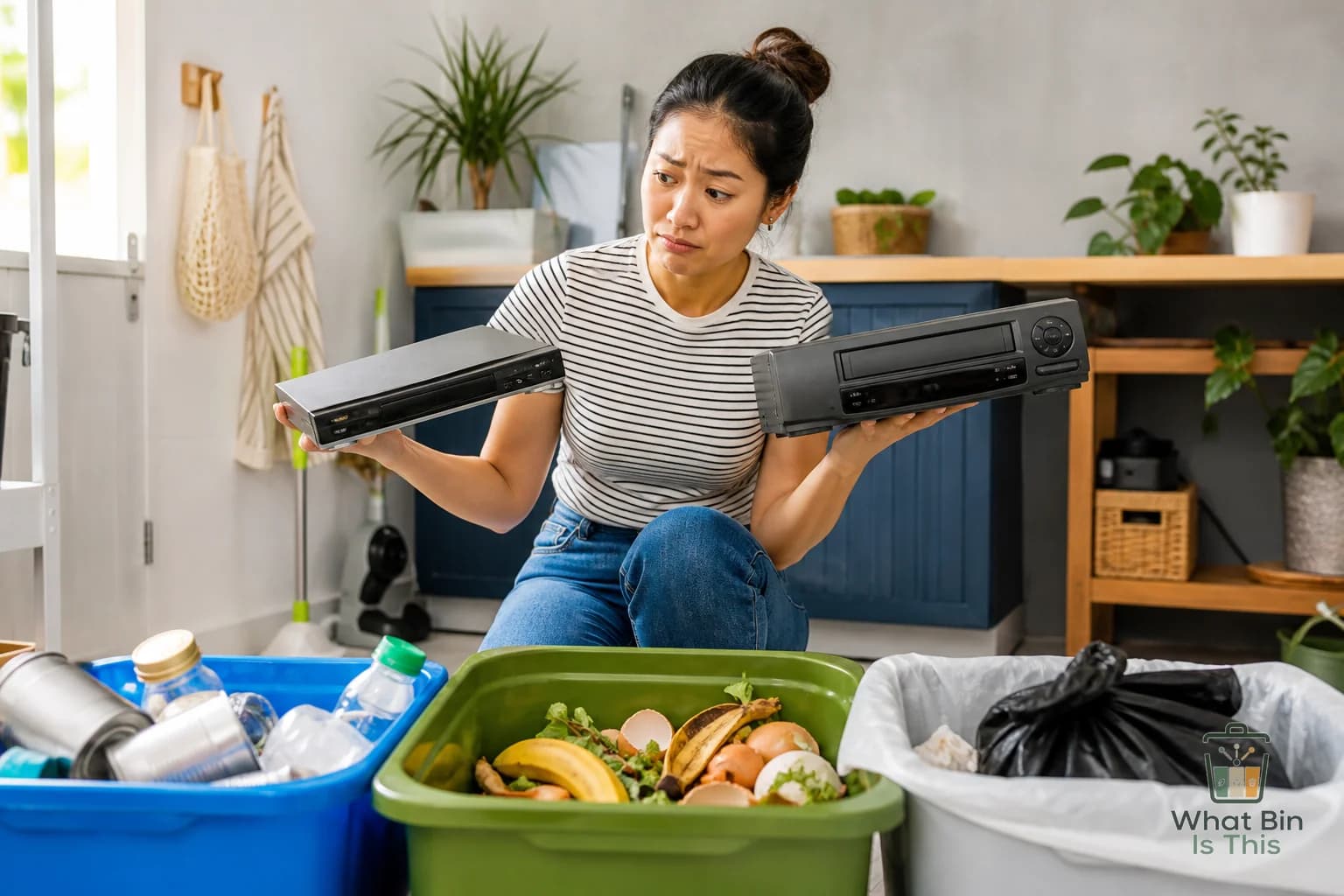
That old DVD player in the cabinet has probably survived three moves, two streaming subscriptions, and one heroic attempt to watch a scratched disc from 2004.
When it finally loses its spot on the shelf, the bin choice is not as obvious as it looks. A DVD player or VCR is mostly a plastic and metal box, but it is still an electronic device with circuit boards, wiring, screws, ports, and sometimes small internal parts that recycling trucks and sorting lines are not built to handle.
Direct answer
Do not put DVD players or VCRs in your curbside recycling bin unless your local program specifically says it accepts small electronics in the cart. Most do not.
The better options are usually:
- Take it to an e-waste drop off site
- Bring it to a retailer or community electronics recycling event if accepted
- Donate it if it works and someone can actually use it
- Use your city or county bulky item or special waste program
- Put it in the trash only if your local rules allow it and no e-waste option is available
DVD players and VCRs are electronic waste, not regular mixed recycling. They may contain recyclable metal and plastic, but they need a different handling path than bottles, cans, paper, and cardboard.
If you are clearing out a whole box of old devices, this is the same basic logic covered in Do old electronics go in the recycling bin?.
Why the answer is not obvious
DVD players and VCRs trick people because they look tame. No leaking battery. No cracked screen. No mystery chemical label. Just a black rectangle with buttons nobody has pressed since the first season of streaming became normal.
But recycling programs are not asking whether an item seems dangerous. They are asking whether the item fits the equipment and sorting process.
A curbside recycling facility is usually set up for common packaging materials. Think cans, bottles, jars, clean paper, and cardboard. A VCR is a small machine. It can tangle, break apart, hide cords, contain circuit boards, and create problems on a sorting line.
The valuable parts are also not recovered well in normal curbside recycling. E-waste programs are designed to pull out metals and manage electronic components more carefully. That is why the right answer is not just recyclable or not recyclable. It is recyclable somewhere else.
Common mistakes
The most common mistake is tossing the whole player into the blue bin because it has plastic and metal in it. That sounds logical at the kitchen level, but it fails at the facility level. Mixed recycling is not a magic machine for every material that might theoretically be recyclable.
Another mistake is cutting off the cord and putting the device in recycling. Removing the cord does not turn a DVD player into an accepted curbside item. You have just made two disposal questions instead of one. Cords and cables usually need e-waste handling too. For more on that, see Can old chargers and cables go in the recycling bin?.
People also forget about the remote. The remote is electronic waste too in many places, and the batteries should be removed before disposal. Loose batteries do not belong in most curbside recycling bins. If the remote uses alkaline batteries, follow your local battery guidance. If it uses button cells or rechargeable batteries, be more careful and use an approved battery drop off.
One more classic mistake: donating broken players. If it does not power on, will not open, eats tapes, or needs a repair nobody is going to make, donation just moves the disposal job to someone else. Working and useful is donation. Broken and obsolete is disposal.
Simple checklist before you get rid of it
Use this quick pass before it leaves the house:
- Unplug the DVD player or VCR
- Remove any disc or tape inside
- Take out batteries from the remote
- Check whether the unit still works
- Wipe dust off if donating
- Bundle cords neatly if taking to e-waste
- Look up your city or county electronics disposal rule
- Do not place it in curbside recycling unless your program clearly allows it
That last line is the annoying but important one. If the local page does not clearly say small electronics are accepted in the recycling cart, assume they are not.
Local rule caveat
Electronics rules vary a lot by location. Some places ban certain electronics from trash. Some offer free e-waste drop off. Some require appointments. Some accept small electronics at transfer stations but not at curbside. Some retailers take limited electronics, but the accepted list can change.
A VCR may also be treated differently from a modern media player in certain programs because of size, weight, or material mix. Do not rely on the fact that your neighbor put one out last year. Neighbor disposal law is not law. It is often just confidence with a bin lid.
Search your city or county site for terms like electronics recycling, e-waste, transfer station, special waste, or small appliances. If the device is part of a larger cleanout, your local waste authority may also have a household electronics day or scheduled drop off event.
Practical takeaway
Old DVD players and VCRs should usually go through e-waste recycling, donation if working, or a local special disposal option. They usually should not go in the curbside recycling bin.
The easy household rule is this: if it plugs in, has ports, has a circuit board, or came with a remote, pause before tossing it in regular recycling. That does not mean it is impossible to recycle. It means the blue bin is probably the wrong door.
When in doubt, check the exact item locally. What Bin Is This can help you sort the weird stuff before it becomes a garage pile with a power cord. Try a lookup at What Bin Is This.