
July 16, 2026
Can you recycle chip bags?
Most chip bags do not belong in curbside recycling. Here is what to check, what to avoid, and when a drop-off option might exist.
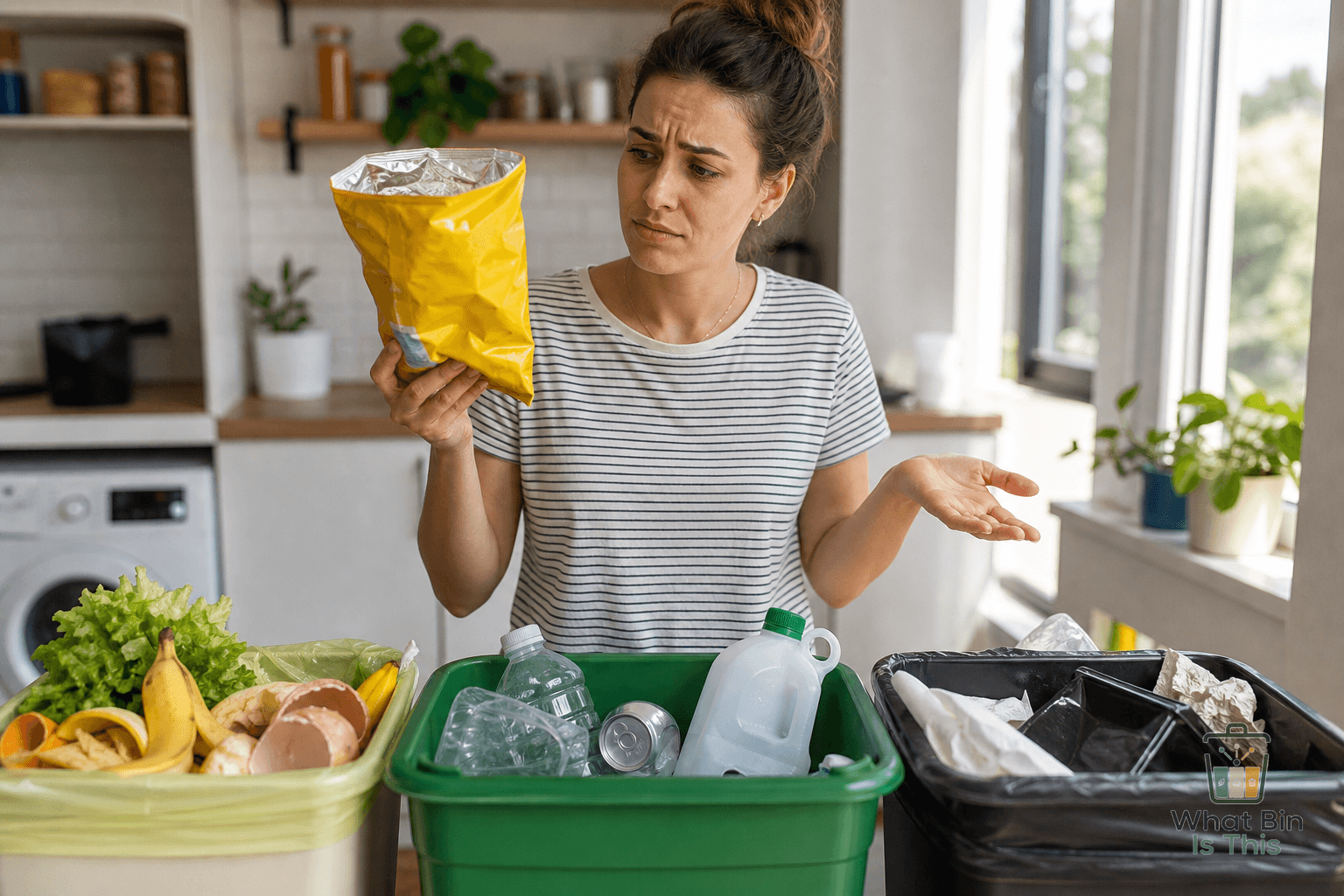
Chip bags look recyclable if you judge by vibes. They are lightweight, shiny, plastic-ish, and covered in packaging symbols that make the whole thing feel more official than it is. So the everyday question is fair: can you recycle chip bags, or are they trash?
For the common search version of the question, can potato chip bags be recycled? Usually, no. Most potato chip bags are flexible multi-layer packaging, not the same thing as a rigid plastic bottle or tub.
But curbside recycling does not run on vibes. It runs on what local sorting facilities can actually sort, sell, and process without jamming equipment or contaminating bales.
For most households, the answer is simple: chip bags usually go in the trash.
The direct answer
Most chip bags should not go in your curbside recycling bin.
In plain terms: you usually cannot recycle chip bags through normal curbside recycling unless your local program explicitly accepts snack bags or flexible pouches.
That includes bags for:
- Potato chips
- Tortilla chips
- Pretzels
- Popcorn
- Snack mixes
- Crackers in foil-lined pouches
- Single-serve snack bags
The reason is that many chip bags are made from flexible, multi-layer packaging. They may include plastic film, foil-like layers, inks, adhesives, and coatings bonded together. That mix is useful for keeping snacks crisp. It is not useful for standard curbside recycling.
If your city or waste company specifically says it accepts snack bags, follow that local rule. Otherwise, put empty chip bags in the trash.
Why chip bags fool people
Chip bags sit in an annoying middle ground.
They are not exactly paper. They are not exactly a plastic bottle. They are not the same as a metal can, even when the inside looks shiny. And they are not the same as clean aluminum foil, which has its own rules.
The shiny lining is the part that throws people off. It can look like foil, but most snack bags are not accepted with metal recycling. Tossing them in with cans does not help. It just gives the sorting line one more weird object to deal with. For the actual foil question, use Can you recycle aluminum foil?.
The bag may also have a recycling-looking symbol somewhere on it. That does not automatically mean it belongs in your home recycling bin. Sometimes the symbol is about the material type. Sometimes it points to a special collection program. Sometimes it is just not enough information to make a curbside decision.
This is where households get tricked: a package can be technically recyclable somewhere without being recyclable in your bin.
Common mistakes with chip bags
The biggest mistake is treating all plastic packaging the same.
A rigid plastic tub and a crinkly snack bag are not handled the same way at many recycling facilities. Rigid containers can be sorted by shape and material. Flexible packaging can wrap around machinery, flatten into paper streams, or get missed entirely.
Another common mistake is putting chip bags into a plastic bag full of recyclables. Bagged recyclables are a separate problem because many facilities do not want recycling tied up inside bags. If you are unsure, read more here: Can plastic bags go in the recycling bin?.
People also try to “improve” the bag by rinsing it. A quick shake to remove crumbs is fine if you are throwing it away, but washing a chip bag does not turn it into curbside recycling. Clean trash is still trash.
And no, cutting the bag into pieces does not help. Smaller pieces are usually harder to sort, not easier.
A simple checklist
Use this quick check before you toss it:
- Is it a crinkly snack bag or pouch? Usually trash.
- Does your local program clearly accept snack bags curbside? If yes, follow that rule.
- Does the package say store drop-off or specialty drop-off? Use that only if the program accepts this exact type of packaging.
- Is it greasy, crumb-filled, or food-covered? Trash.
- Are you guessing because the inside looks like foil? Do not put it with metal recycling.
- Is it a rigid plastic container instead of a flexible bag? Check the local plastic container rules separately.
When in doubt, do not let one questionable bag contaminate a whole bin. That sounds dramatic for a snack bag, but contamination is usually boring stuff like this repeated thousands of times. For a broader look at the issue, see What counts as recycling contamination?.
What about store drop-off programs?
Some stores or brands collect certain flexible plastics. That does not mean every crinkly bag qualifies.
Store drop-off programs often focus on clean, stretchy plastic film, like grocery bags, bread bags, and some plastic wraps. Many chip bags are not stretchy film. They are multi-layer pouches, which may be excluded.
Before saving a pile of snack bags under the sink like a tiny museum of good intentions, check the program instructions. Look for words like “accepted materials” and “not accepted.” If snack bags or multi-layer pouches are not listed, assume they do not belong there.
If the package is part of a specific mail-in or brand-sponsored recycling program, follow that program’s directions. Those programs can change, and they may have limits on brands, packaging types, or locations.
Local rules still matter
Recycling rules are local because sorting equipment, contracts, end markets, and collection systems are local.
One city may reject all flexible packaging. Another may test a special program. A third may accept certain pouches through a drop-off site but not curbside. None of that means your neighbor’s cousin’s rule applies to your kitchen bin.
The safest household rule is this: unless your local recycling guide clearly says chip bags are accepted, keep them out of curbside recycling.
This is not about being perfect. It is about not making the recycling bin do jobs it was not built to do.
Practical takeaway
Most chip bags go in the trash. They are usually flexible, multi-layer packaging, not standard curbside recyclables.
If you see a special drop-off instruction, read it carefully before using it. If your local program clearly accepts snack bags, follow that. Otherwise, empty the crumbs, toss the bag in the trash, and move on with your life.
The recycling bin is not a wish box. It is picky for a reason.
Not sure about a specific package in your kitchen? Check it with What Bin Is This.